Metallurgical Architecture of ASTM A351 CF8 Wafer Check Valves
Understanding the material physics, anti-corrosion chemistry, and fluid dynamics that make CF8 wafer check valves the benchmark for high-reliability industrial fluid handling.
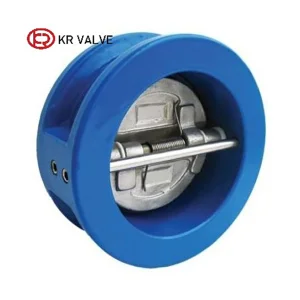
In modern industrial fluid networks, backflow prevention is not merely a mechanical requirement; it is a critical process safety protocol. The CF8 Wafer Check Valve represents the gold standard in non-return valve design for corrosive, high-purity, and high-pressure media. Manufactured primarily from ASTM A351 Grade CF8—the cast equivalent of wrought AISI 304 stainless steel—these valves deliver an exceptional balance of mechanical strength, intergranular corrosion resistance, and economical lifecycle cost.
1.1 Chemical Matrix and Corrosion Resistance
The microstructural stability of CF8 stainless steel relies on its austenitic matrix containing a nominal composition of 18% Chromium and 8% Nickel. Chromium reacts instantaneously with atmospheric or dissolved oxygen to form an ultra-thin, self-healing passive oxide film ($Cr_2O_3$) across the valve body and internal disc surfaces. This passive layer isolates the underlying iron alloy from aggressive chemical attack, mitigating pitting and crevice corrosion even when handling mild acids, organic compounds, and oxidized process fluids.
1.2 Wafer Design Hydrodynamics vs. Flanged Check Valves
The compact "wafer" face-to-face dimension (engineered to standards such as EN 558-1 Series 49, API 594, or DIN 3202-K3) provides profound structural and logistical advantages over traditional flanged swing check valves:
- Weight Reduction: Wafer body check valves weigh up to 75% less than conventional flanged non-return valves, minimizing pipe stress, reducing support bracket costs, and lowering international sea/air freight costs.
- Water Hammer Attenuation: Dual-plate spring-assisted wafer check valves feature dual torsion springs that force the split discs to close prior to flow reversal. This pre-emptive closure prevents hydraulic shock waves (water hammer), protecting downstream pumps, flowmeters, and brittle piping components.
- Space Optimization: The slim structural width enables seamless integration into tight plant layouts, skid-mounted processing units, and modular water treatment facilities.
Information Gain Insight: Unlike standard carbon steel (WCB) valves lined with soft polymers, solid CF8 cast bodies maintain structural integrity across elevated temperatures (-196°C to +400°C depending on seat configuration) without risking liner delamination under full vacuum conditions.
Engineering Data Matrix & Chemical Composition
Rigorous engineering metrics designed to assist valve specifiers, piping engineers, and global EPC procurement leads.
Chemical & Mechanical Standard: ASTM A351 Grade CF8
| Element / Parameter | CF8 (Cast SS304) | CF8M (Cast SS316) | WCB (Cast Carbon Steel) | Testing Method |
|---|---|---|---|---|
| Carbon (C max %) | 0.08% | 0.08% | 0.30% | ASTM A751 Spectrometry |
| Chromium (Cr %) | 18.0% - 21.0% | 18.0% - 21.0% | — | XRF Material Verification |
| Nickel (Ni %) | 8.0% - 11.0% | 9.0% - 12.0% | — | Optical Emission Spectrometry |
| Molybdenum (Mo %) | — | 2.0% - 3.0% | — | Chemical Wet Analysis |
| Tensile Strength (MPa min) | 485 MPa | 485 MPa | 485 MPa | ASTM E8 Mechanical Test |
| Yield Strength (MPa min) | 205 MPa | 205 MPa | 250 MPa | Proof Load Tensile Test |
| Pitting Resistance Equivalent (PREN) | ~19.0 | ~25.0 | N/A | Calculated PREN Formula |
Dimensional Range & Pressure Class Compatibility
| Nominal Diameter (DN) | Inches (in) | Pressure Class (PN / ANSI) | Face-to-Face Standard | Primary Sealing Options |
|---|---|---|---|---|
| DN40 - DN100 | 1.5" - 4" | PN10, PN16, PN25, Class 150 | API 594 / EN 558-1 | PTFE, EPDM, NBR, Viton, Metal |
| DN125 - DN300 | 5" - 12" | PN10, PN16, PN25, Class 150/300 | DIN 3202-K3 / API 594 | EPDM, Viton, Stellite Metal Seat |
| DN350 - DN600 | 14" - 24" | PN10, PN16, PN25, Class 150 | ISO 5752 Series 16 | Resilient Rubber / Stainless Overlay |
| DN700 - DN1200+ | 28" - 48" | PN6, PN10, PN16 | Manufacturer Standard / Custom | Vulcanized EPDM / Metal-to-Metal |
China Factory Supply Chain & Precision Manufacturing Ecosystem
Why sourcing wholesale CF8 wafer check valves directly from OEM Chinese manufacturers yields decisive competitive advantages for global buyers.
Advanced Silica Sol Investment Casting
Leading Chinese foundries utilize automated silica sol investment casting processes for CF8 stainless steel bodies. This ensures flawless dimensional tolerances (CT4-CT6), smooth surface finishes (Ra 3.2–6.3 µm), and complete elimination of internal blowholes or sand inclusions.
CNC Machining & Spectral Analysis
Every valve component undergoes precision multi-axis CNC machining for tight seating tolerances. In-house German SPECTRO Direct-Reading Spectrometers verify 100% heat-number chemical compliance prior to body pouring.
Economies of Scale & OEM Customization
By leveraging concentrated industrial clusters in Tianjin and Zhejiang, Chinese manufacturers provide custom flange drilling (ANSI B16.5, EN 1092-2, JIS B2220), custom branding/laser etching, and specialized trim materials with minimum lead times.
Vertical integration within China's valve manufacturing sector spans raw material refining, rubber/elastomer vulcanization, spring coiling, dynamic flow testing, and export packaging. This complete supply chain control guarantees stable production lead times—even during global logistics fluctuations or high-volume wholesale orders.
Global Procurement Dynamics & Compliance Assurance
Navigating international engineering standards, quality assurance procedures, and documentation required for EPC contracts.
API 598 Pressure Testing
Every CF8 wafer check valve undergoes 100% shell hydrostatic testing (1.5x PN) and seat tightness testing (1.1x PN high-pressure hydro & low-pressure air) to verify zero leakage across elastomer or metal seats.
EN 10204 3.1 Certification
Full traceability is provided via Mill Test Certificates (MTC) accompanying every shipment. Chemical heat analysis, mechanical tensile/impact test values, and NDT reports are directly linked to serial numbers.
International Directives
Compliance with European Pressure Equipment Directive (PED 2014/68/EU CE marking), WRAS/NSF-61 for potable water safety, and ATEX directives for hazardous explosive atmospheres.
Total Cost of Ownership (TCO) Calculation: Purchasing CF8 wafer check valves from quality-certified manufacturers reduces long-term operational expenditures (OpEx) by preventing unscheduled plant shutdowns, reducing pump energy consumption through optimized flow coefficients ($C_v$), and eliminating pipeline vibration wear.
Localized Application Scenarios & Severe Service Deployment
How CF8 stainless steel wafer check valves solve specific engineering challenges across global process industries.
Chemical Processing & Refineries
CF8 valves prevent hazardous acid/solvent backflow in organic chemical synthesis lines. Stainless steel internals resist nitric acid, organic solvents, and caustic cleaning solutions (CIP/SIP) up to 200°C when paired with PTFE soft seals.
Seawater Desalination (RO Plants)
In high-pressure Reverse Osmosis (RO) pump discharge lines, CF8 wafer check valves offer superior resistance to brackish water corrosion compared to ductile iron, maintaining structural stability against continuous pressure pulsing.
HVAC & Commercial Building Water
High-rise chilled water and district heating networks utilize dual-plate CF8 wafer check valves at main circulation pump stations to eliminate noise pollution caused by water hammer and valve slam.
Industry Development Trends: Next-Gen Valve Technologies
Innovations shaping the future of industrial non-return valves in energy transition and digital manufacturing.
6.1 Smart Valve Monitoring & Acoustic Sensors
The integration of Industrial Internet of Things (IIoT) sensors directly into check valve bodies is transforming predictive maintenance. External wireless acoustic emission sensors now detect micro-leakage past the valve seat and track spring degradation cycles in real-time, sending data directly to SCADA systems before catastrophic backflow events occur.
6.2 Low-Carbon Foundry Operations & Green Hydrogen Preparedness
As global environmental regulations tighten, Chinese valve factories are transitioning to electric induction furnaces powered by renewable energy grids. Furthermore, CF8 and ultra-low carbon CF3 variants are undergoing helium tightness testing to certify non-return valves for emerging Green Hydrogen transportation networks and carbon capture, utilization, and storage (CCUS) facilities.
Frequently Asked Questions
Comprehensive technical answers for buyers, engineers, and supply chain directors.