
Featured Industrial Wafer Valves | Boston Regional Stock
Engineered for ultra-compact face-to-face dimensions, high pressure-temperature tolerances, and bubble-tight isolation across New England's most demanding facility loops.
The Greater Boston Industrial & Infrastructure Landscape
Analyzing the commercial density, environmental constraints, and technical flow control demands driving wafer-type valve selection across Massachusetts mechanical networks.
High-Density Urban & BioPharma Footprint
The Greater Boston metropolitan area—anchored by Cambridge’s Kendall Square, the Seaport Innovation District, and the Route 128 technological corridor—represents one of North America's highest concentrations of life sciences, academic medical centers, and urban commercial real estate. In these facilities, real estate valuation commands up to $1,200 per square foot, making mechanical room footprint optimization a critical engineering mandate.
Traditional flanged valves present heavy structural loads and long face-to-face dimensions (lay lengths) that consume valuable floor space and require elevated structural support hangers. Wafer-type check and butterfly valves solve this architectural dilemma by offering up to a 75% reduction in face-to-face width and up to a 60% reduction in total weight compared to standard flanged swing check valves. This footprint compacting allows mechanical contractors to integrate high-density piping manifolds within micro-skids for biopharmaceutical cleanrooms and high-rise commercial towers.
Thermal District Energy & MWRA Grid Demands
Boston's climate demands robust seasonal thermal management. System operators like Vicinity Energy manage extensive district steam and chilled water networks beneath downtown Boston and Cambridge. Simultaneously, the Massachusetts Water Resources Authority (MWRA) delivers potable water and wastewater treatment (such as the Deer Island Treatment Plant) to 3.1 million residents across 61 communities.
Flow control components in these networks must withstand continuous cycling, severe pressure surges, and corrosive thermal fluid chemistries. Wafer dual-plate check valves deliver superior hydrodynamic efficiency, minimizing dynamic pressure loss ($C_v$ optimization) and eliminating high-energy pump parasitic drag. Furthermore, spring-loaded dual disc designs mitigate the destructive impact of hydraulic shock (water hammer) during sudden pump shut-offs, protecting aged municipal mains and high-pressure steam condensate loops throughout New England.
Engineering Architecture of Wafer Type Valves
An exhaustive technical evaluation of internal fluid dynamics, disc geometry, sealing mechanics, and material metallurgy designed for process engineers and municipal designers.
Dual-Plate Spring-Assisted Closure Mechanics
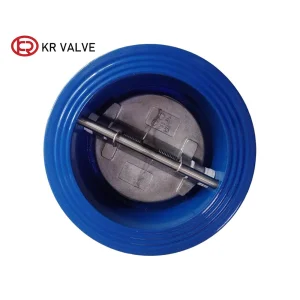
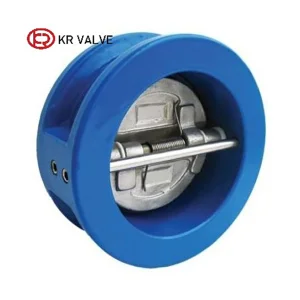
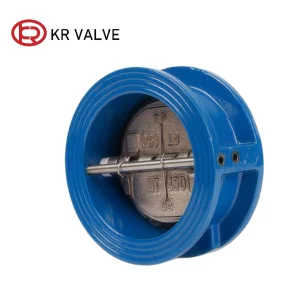
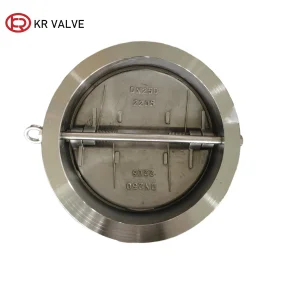
The wafer dual-plate check valve represents a significant evolutionary leap over conventional single-disc swing check valves. Operating on a central hinge pin equipped with twin torsion springs, the valve utilizes two semi-circular plates (discs) that fold inward under forward fluid pressure and snap closed rapidly as forward velocity decelerates to zero.
1. Non-Slam Anti-Hammer Response
The spring force closes the dual plates prior to actual fluid flow reversal. By eliminating reverse velocity buildup, the dynamic shock wave known as water hammer is virtually eradicated, safeguarding delicate heat exchangers and digital flow meters.
2. Low Head Loss ($C_v$) Geometry
Aerodynamically contoured discs reduce fluid turbulence and friction loss across the valve body. This engineered flow path directly translates to lower operational kilowatt usage for high-capacity circulation pumps in commercial HVAC loops.
3. Multi-Orientation Installation
Unlike gravity-dependent traditional swing check valves, spring-loaded wafer valves operate flawlessly in horizontal, vertical-upward, or inclined piping configurations, giving system designers total piping freedom.
Valve Architecture Performance Matrix
| Performance Vector | Wafer Dual-Disc Check | Lug Butterfly Valve | Traditional Flanged Swing Check |
|---|---|---|---|
| Face-to-Face Standard | API 594 / ASME B16.10 Short | API 609 Category A / ISO 5752 | ASME B16.10 Long Series |
| Installed Weight (DN200 / 8") | ~16 kg (Lightweight) | ~22 kg (Moderate) | ~68 kg (Heavy Load) |
| Water Hammer Prevention | Superior (Spring Assisted) | N/A (Isolation Only) | Poor (High Reverse Velocity Slam) |
| Sealing Capability | Resilient (EPDM/PTFE) / Metal-to-Metal | Zero Leakage Soft Seat | Metal-to-Metal / Resilient Option |
| Maintenance Accessibility | Easy inline removal between flanges | Dead-end downstream service capable | Requires full flange separation & crane hoist |
Regional Compliance, Standards & QA Assurance
Navigating Massachusetts environmental codes, municipal water authority specifications, and industrial safety certifications.
MassDEP & Potable Water Standards
For municipal drinking water installations under MassDEP (Massachusetts Department of Environmental Protection) oversight, all wetted elastomer materials must conform strictly to NSF/ANSI 61 for health effects and NSF/ANSI 372 for lead-free compliance. Ductile iron bodies are coated internally and externally with fusion-bonded epoxy (FBE) to AWWA C550 standards, preventing tuberculation and bio-film accumulation in Boston water mains.
ASME B31.1 & B31.3 Pressure Piping
Thermal district energy lines and pharmaceutical process loops operating in Cambridge biopharmaceutical campuses are built to ASME B31.1 (Power Piping) or ASME B31.3 (Process Piping) specifications. Valves must feature pressure-retaining bodies rated to ANSI Class 150/300/600, certified shell testing at 1.5 times working pressure, and non-destructive examination (NDE) of castings.
LEED v4 Building Decarbonization
Boston's Building Energy Reporting and Disclosure Ordinance (BERDO 2.0) sets aggressive net-zero emissions targets for commercial structures. Utilizing ultra-low pressure drop wafer check valves decreases overall hydraulic resistance, directly assisting mechanical engineers in achieving LEED v4 energy efficiency points by reducing annual pumping electrical loads.
Global Supply Chain: Direct Factory Advantage
Bridging Tier-1 Chinese valve manufacturing hubs (Tianjin) directly with Boston EPC contractors, distributors, and plant operators to optimize total cost of ownership (TCO).
Advanced Foundry Metallurgy & Precision Machining
Our manufacturing complex in Tianjin leverages modern induction melting furnaces, automated resin sand casting, and multi-axis CNC machining centers. By exercising total end-to-end control over material chemistry—from high-grade Ductile Iron (ASTM A536 65-45-12 / GGG40) to CF8M (SS316) and Duplex Stainless Steels—we deliver consistent dimensional integrity compliant with international face-to-face standards (BS5153, DIN F5, API 594, AWWA C594).
Every raw material melt is verified using Optical Emission Spectroscopy (OES) to guarantee zero chemical deviation, ensuring that stainless steel wafer discs intended for aggressive bio-process media exhibit total resistance to pitting and crevice corrosion.
40-60% TCO Reduction with Guaranteed Quality
Procuring industrial wafer valves through traditional North American distributor markups often incurs heavy compounding margins. Partnering direct-with-factory delivers a 40% to 60% total cost reduction without compromising engineering specifications.
- 100% Factory Inspection: Shell test at $1.5\times \text{PN}$ and seat test at $1.1\times \text{PN}$ conducted on 100% of manufactured units (ISO 5208 Rate A zero-leakage standard).
- OEM Customization: Custom stem extensions, gear operators, pneumatic/electric actuators, special coating colors, and private-label tagging tailored to Boston municipal contract requirements.
- Rapid Freight Logistics: Streamlined sea freight delivery directly into the Port of Boston (Conley Terminal) or expedited air freight via Boston Logan Airport for urgent shutdown projects.
New England Field Applications & Engineering Cases
Real-world deployment examples demonstrating how wafer type valves optimize performance in regional infrastructure projects.
Kendall Square Bio-Lab Chilled Water Loop
Challenge: A multi-story life science laboratory in Cambridge required high-density chilled water manifolds. Space inside mechanical shafts was restricted, and water hammer from pump cycles threatened sensitive glass process reactors.
Solution: Installed 4-inch and 8-inch Stainless Steel Wafer Dual-Disc Check Valves (AWWA C594 / CF8 Disc). The spring-assisted closure completely mitigated pressure surges, while compact wafer dimensions allowed tight skid assembly, saving 40% shaft volume.
Boston Urban District Steam Condensate Loop
Challenge: High-temperature steam condensate lines experienced severe cavitation and rapid wear on conventional metal-seated swing check valves.
Solution: Supplied WCB Cast Steel Wafer Check Valves with high-temperature PTFE encapsulated seals and SS316 internal plates. Operating reliably up to 220°C, the replacement valves reduced maintenance downtime by 85% across two heating seasons.
Boston Harbor Drydock Dewatering Facility
Challenge: High-salinity tidal water dewatering pumps in South Boston suffered from severe salt-spray atmospheric corrosion and bio-fouling on heavy flanged check valves.
Solution: Deployed Ductile Iron Wafer Dual-Plate Check Valves lined with high-durability EPDM and fitted with Bronze/CF8 discs. The lightweight wafer design enabled rapid offshore installation and superior saltwater corrosion resistance.
Complete Wafer & Industrial Valve Catalog | Factory Direct
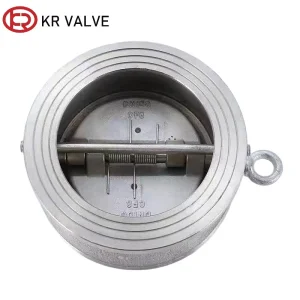
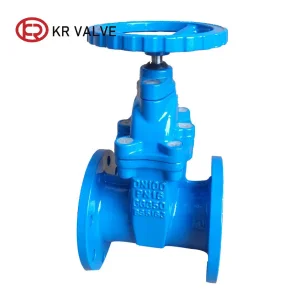
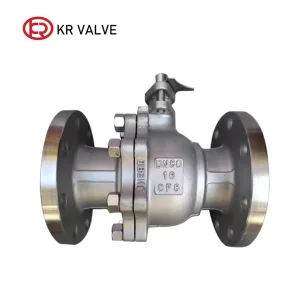
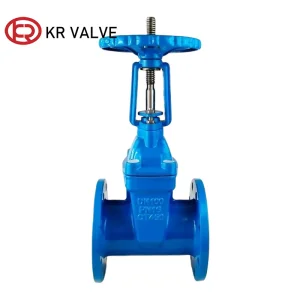
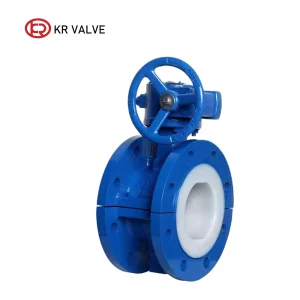
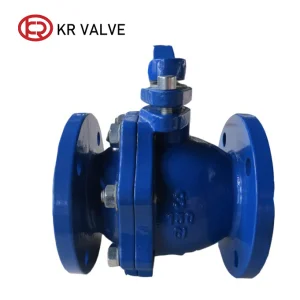
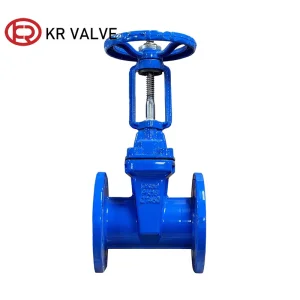
Explore our comprehensive catalog of wafer dual-plate check, resilient gate, PTFE-lined butterfly, and flanged ball valves engineered for global enterprise standards.
Frequently Asked Questions | Boston Valve Procurement
Technical answers covering valve engineering, installation between standard ANSI flanges, material selection, and factory direct shipping options.
Ready to Optimize Your Boston Piping Infrastructure?
Connect directly with our valve application engineers for custom CAD drawings, material datasheets, and competitive factory-direct pricing for your project.
Send Inquiry Now