Featured Engineering Valve Series
Explore our high-performance industrial valves manufactured to DIN, BS, and ANSI international standards for waterworks, municipal pipelines, and heavy-duty processing systems.
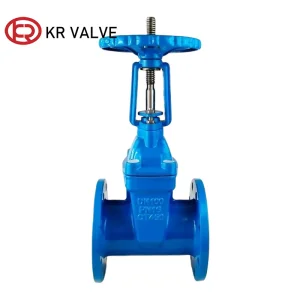
Technical Blueprint: DIN F4 (EN 558-1 Series 14) Gate Valve Design
Understanding the structural, metallurgical, and fluid dynamics advantages of standard short face-to-face resilient seated gate valves in global engineering projects.
Dimensional Precision & Face-to-Face Standardisation
The DIN F4 gate valve standard (governed internationally under DIN 3202-F4 and harmonized as BS EN 558-1 Series 14) specifies a short structural face-to-face footprint. Compared to its longer counterpart, the DIN F5 (Series 15), the DIN F4 valve minimizes overall pipeline spatial requirement by up to 25% while maintaining full hydrostatic pressure integrity.
This compact architectural footprint makes DIN F4 resilient seated gate valves the primary choice for subterranean utility vaults, prefabricated pumping skids, municipal water distribution manifolds, and marine ballast piping networks where spatial envelope optimization directly impacts capital expenditure (CAPEX).
Advanced Metallurgy: Ductile Iron GGG40 / GGG50
Modern DIN F4 gate valves produced by leading Chinese OEMs replace legacy gray cast iron with spheroidal graphite ductile iron—specifically EN-GJS-400-15 (GGG40) or EN-GJS-500-7 (GGG50). Nodular graphite structures confer superior tensile strength (≥ 400 MPa) and elongation capacity (≥ 15%), ensuring high resistance against water hammer transients and thermal stresses.
Every batch of raw cast body undergoes optical emission spectrometry (OES) analysis to verify compliance with carbon, silicon, and manganese ratios before entering high-precision multi-axis CNC machining centers.
| Technical Parameter | Standard Specification (DIN F4 Series 14) | High-Gain Option / OEM Capability |
|---|---|---|
| Design & Manufacturing | DIN 3352 Part 4 / EN 1171 / BS 5163 | Customized top flange to ISO 5210 for Actuation |
| Face-to-Face Dimensions | DIN 3202-F4 / EN 558-1 Series 14 | Short-pattern ANSI B16.10 replacement modifications |
| Flange Drilling Standards | EN 1092-2 (PN10 / PN16 / PN25), DIN 2501 | Dual-drilled BS4504 / ANSI Class 150 patterns |
| Wedge Encapsulation | EPDM (Drinking Water Certified WRAS / DVGW) | NBR (Oil/Hydrocarbon resistant), FKM (High Chem) |
| Stem Material | Stainless Steel X20Cr13 (AISI 420) / SS304 | Duplex Stainless Steel AISI 316 / Duplex 2205 stem |
| Corrosion Protection | Fusion Bonded Epoxy Coating (FBE) ≥ 250 µm | GSK Approval, High-Temp Ceramic Epoxy Coating |
| Hydrostatic Testing | Shell: 1.5x PN | Seat: 1.1x PN (EN 12266-1) | 3rd Party Inspection (SGS, TUV, BV) 100% Verified |
China Factory 4.0: Modern Manufacturing & Supply Chain Resilience
How digitalized foundry operations, automated machining, and lean logistics empower international wholesale buyers with unparalleled price-to-performance ratios.
Automated Lost-Foam & Resin Sand Casting
Leading Chinese DIN F4 gate valve manufacturers utilize automated resin sand molding lines alongside lost-foam casting technologies. This automated process minimizes dimensional tolerances, eliminates interior sand inclusions, and ensures a smooth hydrodynamic internal passage (surface roughness Ra ≤ 12.5 µm), significantly reducing friction loss coefficients ($K$-factor).
Smart Robotics & Vulcanization Line
The wedge sealing mechanism relies on absolute bonding between the ductile iron core and its EPDM elastomer matrix. Advanced factories implement continuous high-temperature vacuum vulcanization presses. Coupled with computerized adhesive application systems, this guarantees peel strength exceeding 8 N/mm, preventing rubber detachment under high shear flow velocity (> 5 m/s).
Vertical Integration & Stock Management
By establishing vertically integrated production—from scrap iron sorting, melting, machining, electrostatic powder coating, to hydrostatic shell/seat testing—China's manufacturing clusters in Tianjin and Zhejiang offer wholesale distributors stable production timelines, low MOQ thresholds, and flexible OEM branding packages tailored for regional tenders.
Macro Industry Solutions: Engineering Applications
Customized flow isolation solutions designed to withstand harsh operating environments, chemical stress, and stringent sanitation codes worldwide.
1. Municipal Potable Water Infrastructure & Desalination
In municipal clean water networks, non-toxic elastomeric seals and non-contaminating internal coatings are mandatory. DIN F4 gate valves built with WRAS, DVGW, or NSF/ANSI 61 certified EPDM wedges provide absolute zero-leakage isolation without imparting odor or leaching harmful heavy metals into public drinking water supplies.
For reverse-osmosis (RO) sea-water desalination plants, internal fluid channels are protected with high-thickness electrostatic epoxy or optional duplex stainless steel trim to prevent pitting corrosion caused by high chloride ion concentrations.
2. Sewage Treatment, Slurry & Industrial Wastewater
Untreated municipal effluent and industrial process wastewater carry high quantities of suspended solids, fibrous rags, and gritty particles. Legacy metallic-seated gate valves suffer from groove clogging at the bottom seat pocket, preventing tight shut-off.
Resilient seated DIN F4 gate valves feature a smooth, pocketless full-bore bottom structure. Suspended solids pass unhindered through the valve body. As the EPDM wedge closes, it encapsulates minor foreign particles inside its soft rubber body, returning to its original geometry upon reopening without damaging the sealing surface.
3. District Heating & HVAC Chilled Water Distribution
Commercial HVAC skids and district heating primary networks require reliable flow isolation capable of cycling through thermal expansion and contraction. DIN F4 gate valves fitted with high-temperature grade EPDM (up to +120°C) or NBR seals operate reliably across seasonal duty shifts.
Low operating torque requirements allow smaller, energy-efficient electric actuators or pneumatic cylinders to be mounted via standard ISO 5210 top flanges, reducing automation hardware costs for smart building management systems (BMS).
4. Industrial Firefighting Networks (UL/FM Standard Alignment)
Fire protection mains demand immediate, fail-safe valve opening even after years of static inactivity. DIN F4 gate valves manufactured with high-durability brass/bronze stem nuts and low-friction stem O-ring seals ensure low breakaway torque under high differential pressure.
Optional post indicator flange setups (PIV) and tamper switch assemblies allow real-time position monitoring integrated directly into centralized fire command centers.
Technology Roadmap & Future Outlook: Next-Gen Gate Valves
Pioneering smart digital integration, sustainable manufacturing, and zero-emission fluid control solutions for the upcoming decade.
IoT Digital Twin & Smart Sensing Integration
The future of municipal flow control centers on continuous condition monitoring. Next-gen DIN F4 gate valves are being equipped with embedded micro-sensors within the gland packing and bonnet cavity. These sensors track localized pressure spikes, acoustic vibration signatures (cavitation warnings), and stem stroke counters.
Transmitting data via NB-IoT or LoRaWAN protocols, these smart gate valves feed real-time diagnostics into digital twin municipal platforms, shifting water utility maintenance from reactive repair to predictive overhaul.
Hydrogen & Green Gas Line Adaptation
As global energy systems transition toward hydrogen blending and biogas transportation, valve sealing mechanisms must evolve to eliminate ultra-small gas molecule permeation. Advanced research focuses on self-healing fluoroelastomer matrices and ion-plated stem surfaces that withstand hydrogen embrittlement while retaining bubble-tight seal integrity under cyclic gas pressure loading.
Carbon-Neutral Foundry & Recyclable Materials
Under global Scope 1 & Scope 2 decarbonization targets, Chinese tier-1 valve manufacturers are converting traditional cupola furnaces to electric induction melting powered by renewable solar/wind microgrids. Furthermore, new bio-based EPDM formulations and 100% recyclable epoxy powder coatings ensure a lower embodied carbon footprint throughout the valve's 50-year lifecycle.
Global Procurement Guide: Compliance, Quality Assurance & TCO
A rigorous blueprint for EPC contractors, engineering consultants, and international wholesale buyers to evaluate suppliers and minimize Total Cost of Ownership.
Quality Assurance Protocols & Testing Certification
Procuring wholesale valves from overseas requires transparent proof of quality compliance. A dependable manufacturing partner must provide complete traceability documentation with every consignment:
- EN 10204 3.1 Material Test Certificates (MTC): Detailing chemical composition and mechanical stress testing for bodies, bonnets, and stems.
- Hydrostatic Test Reports: 100% shell testing at 1.5x nominal pressure and seat closure testing at 1.1x nominal pressure in accordance with EN 12266-1 / ISO 5208.
- Coating Thickness & Continuity Verification: Magnetic thickness measurement (minimum 250 µm DFT) and high-voltage holiday testing (3 kV spark test) ensuring zero pinhole voids in epoxy protection.
Total Cost of Ownership (TCO) Optimization
While initial purchase price is critical for wholesale margins, long-term operational costs dictate overall project profitability. Opting for premium DIN F4 gate valves with low breakaway torque reduces electrical load on automated actuators over millions of duty cycles.
Furthermore, replaceable stem seal O-rings under full operating pressure (back-sealing capability) allow routine maintenance without shutting down main pipeline pressure, virtually eliminating costly operational downtime for industrial facilities.
Frequently Asked Questions (Engineering & Procurement Q&A)
Detailed answers to technical, manufacturing, and international trade inquiries curated by senior valve engineers.
What is the main structural difference between DIN F4 and DIN F5 gate valves?
The fundamental difference lies in their face-to-face overall body length standard governed by DIN 3202 / EN 558-1. DIN F4 corresponds to Series 14 (short pattern), while DIN F5 corresponds to Series 15 (long pattern). For instance, at DN100 (4 inches), a DIN F4 gate valve has a face-to-face length of 190 mm, whereas a DIN F5 gate valve measures 230 mm.
Both valve types share identical flange drilling, pressure ratings, and internal seating mechanisms. DIN F4 is selected when compact spatial dimensions are needed to reduce pipeline skid sizes and freight weight, whereas DIN F5 is commonly specified in legacy European installations as a direct drop-in replacement.
Why choose a Resilient Seated Gate Valve over a Metal Seated Gate Valve for waterworks?
Resilient seated gate valves utilize a ductile iron wedge fully encapsulated in an elastomer (such as EPDM or NBR). When closed, the elastic deformation of the rubber wedge achieves 100% bubble-tight, zero-leakage shut-off (EN 12266-1 Rate A) even if fine particulate debris is present in the line.
Conversely, traditional metal-seated gate valves rely on precise metallic wedge-to-body seat contact. Minor debris or tuberculation scale can scratch the metal seating surfaces, causing permanent leakage. Furthermore, resilient seated valves feature a flat, pocketless bottom bore that eliminates sediment trap zones.
What coating standard is applied to prevent corrosion on Chinese manufactured DIN F4 gate valves?
Standard export-grade DIN F4 gate valves are protected with electrostatically applied Fusion Bonded Epoxy (FBE) powder coating in accordance with DIN 30677-2 guidelines. The minimum Dry Film Thickness (DFT) is 250 micrometers (µm).
For drinking water applications, coatings comply with international hygiene approvals such as GSK, WRAS, DVGW, or NSF/ANSI 61. Epoxy coatings are applied both internally and externally to protect the ductile iron casting from soil corrosion, galvanic currents, and aggressive fluid medium attack.
Can DIN F4 gate valves be customized with electric or pneumatic actuation top flanges?
Yes. While manual handwheel or cap-top gearbox operations are standard, Chinese OEM factories frequently manufacture DIN F4 gate valves with standardized top mounting flanges conforming to ISO 5210 / ISO 5211. This allows seamless field or factory mounting of electric quarter-turn/multi-turn actuators (e.g., Rotork, AUMA, SIPOS) or double-acting pneumatic actuators for automated system control.
What are the typical Lead Times and Minimum Order Quantities (MOQ) for wholesale valve orders?
For standard DIN F4 gate valves (DN50 to DN300 in PN10/PN16 with standard blue RAL5015 epoxy coating), leading manufacturers maintain raw casting stock, enabling lead times of 15 to 25 days. Custom engineering modifications (special alloys, high-temperature seals, non-standard drilling) typically require 35 to 45 days.
MOQ varies by nominal diameter: smaller valves (DN50-DN150) generally start at 20-50 units per size, while large-diameter valves (DN300 and above) can be ordered individually or consolidated in mixed-container shipments.
How do factories ensure rubber bonding integrity on EPDM encapsulated wedges?
Rubber delamination is prevented through a three-stage quality protocol: First, the ductile iron wedge core is shot-blasted to SA 2.5 finish to create a micro-textured mechanical anchor profile. Second, a high-performance chemical bonding agent is uniformly applied via robotic spray arms. Third, vulcanization takes place under high hydraulic pressure in computer-controlled vacuum molding presses, ensuring chemical cross-linking between the rubber and metal substrate.
Complementary Flow Control Products
Complete your pipeline engineering package with our comprehensive range of check valves, air release valves, strainers, and control valves.